A fixed Air Conditioning system has to be installed by
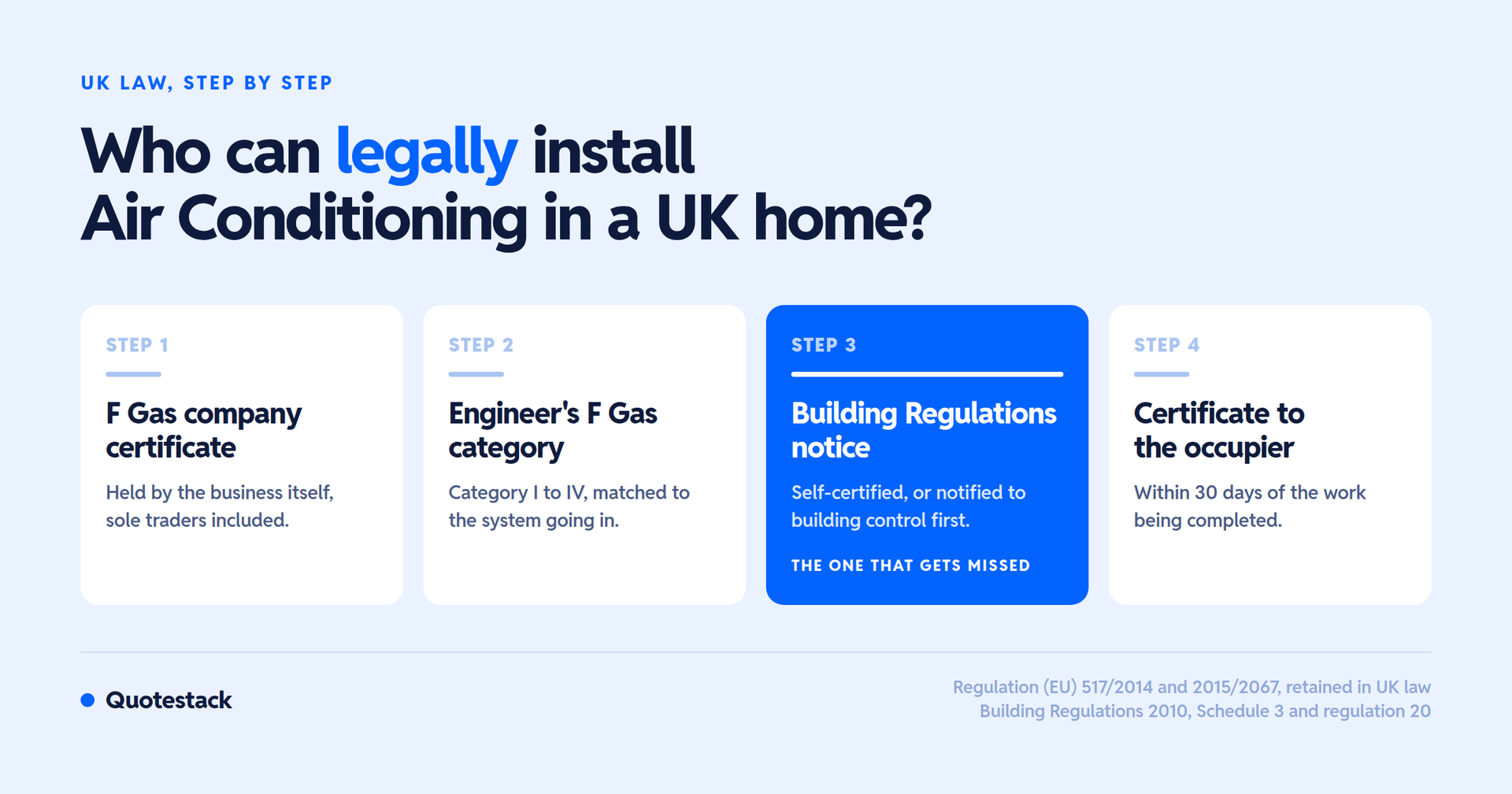
a business that holds an F Gas company certificate, using an engineer who holds their own F Gas certificate in a category that covers the work. That is not a trade preference or a manufacturer's warranty condition. It is the law across Great Britain, and it is also why a wholesaler will not sell you a split system over the counter without asking who is fitting it.
There is a third requirement that gets missed far more often than the first two. In England and Wales, putting a fixed Air Conditioning system into a home is building control work. It has to be either self-certified by an installer registered with a competent person scheme, or notified to the local authority before it starts.
So the honest answer is: a certified company, a certified engineer, and a piece of paperwork that reaches building control. Here is each one, in the order it happens.
Step 1: The company needs its own certificate
This is the one homeowners never think to ask about, because everyone assumes certification is something an individual holds.
Under the retained F gas rules, certification works at two levels. Commission Implementing Regulation (EU) 2015/2067, retained in UK law at the end of 2020, sets the minimum requirements for both. Article 6 covers companies, and a company certificate is issued on evidence that the business employs certified people and has "proof that the necessary tools and procedures are available" for them to do the work.
In practice that means the business itself is registered with a certification body. REFCOM is the best known in the UK, and it runs a public company search where you can type in a name or a postcode and see whether a company is on the register, along with its town and contact details. Bureau Veritas runs a scheme too.
Sole traders are not exempt. A one-person Air Conditioning business is still an undertaking carrying out the work, and still needs a company certificate alongside the engineer's personal one.
Step 2: The engineer needs a category that covers the system
The personal certificate is not a single qualification. Article 2 of the same regulation splits it into four categories:
- Category I - all activities: leak checking, recovery, installation, repair, maintenance, servicing and decommissioning, on any size of system
- Category II - the same activities, but only on equipment containing less than 3 kg of F gas, or less than 6 kg where the system is hermetically sealed and labelled as such
- Category III - recovery only, within the same 3 kg and 6 kg limits
- Category IV - leak checking only, where it "does not entail breaking into the refrigeration circuit"
The qualifications behind those categories have to come from City and Guilds, the Building Engineering Services Association or LCL Awards, or a recognised equivalent, according to the Government's own guidance.
Whether a particular job sits inside the Category II cap depends on the refrigerant charge of the system going in, which is printed on the unit and listed in its datasheet. A single room wall unit and a multi-split serving four rooms with long pipe runs are not the same proposition. If you are a homeowner, the useful question is not "are you F Gas registered" but "which category, and does it cover the system you are quoting me".
Step 3: The building control step almost nobody mentions
This is the one that gets skipped, and it is the one a solicitor may ask about when the house is sold.
Schedule 3 of the Building Regulations 2010 lists the work that a registered installer can self-certify instead of going through the council. Entry 6 reads, in full:
Installation of an air conditioning or ventilation system in a dwelling, that does not involve work on a system shared with other dwellings.
Four scheme operators are named against it: Blue Flame Certification Limited, Building Engineering Services Competence Assessment Limited (BESCA), Certsure LLP and NAPIT Registration Limited. Entry 5 does the same job for buildings that are not dwellings.
The existence of that entry is the point. Self-certification is a shortcut around notifying building control, and you only need a shortcut around something that would otherwise apply. If your installer is not registered with one of those four schemes, the work has not stopped being building control work. It just has to go to the local authority the long way round, before it starts.
Scotland runs a separate building standards system and Northern Ireland has its own building control rules, so this step works differently in both.
Step 4: The paperwork you should be holding afterwards
Where the work is self-certified, regulation 20 of the Building Regulations 2010 sets out what happens next. Within 30 days of the work being completed, the registered installer has to give the occupier a copy of the compliance certificate, and give the building control authority either that certificate or notice that the work has been done.
So if you have had Air Conditioning fitted in England or Wales by a scheme-registered installer, a Building Regulations compliance certificate should land with you inside a month. If one never arrives, that is worth a phone call now rather than on the day a buyer's solicitor asks for it.
Why you cannot just buy one online and have a mate fit it
This is the rule that catches people out, and it is short enough to quote.
Article 11(5) of Regulation (EU) No 517/2014, retained in Great Britain, says:
Non-hermetically sealed equipment charged with fluorinated greenhouse gases shall only be sold to the end user where evidence is provided that the installation is to be carried out by an undertaking certified in accordance with Article 10.
A standard wall mounted split system is not hermetically sealed. It arrives as an indoor unit and an outdoor unit, and someone has to pipe them together and commission the system on site. So the seller has to see evidence that a certified company is doing the install before it can be sold to a householder.
That is the difference between a split system and a plug-in portable. A portable is a sealed, factory-charged appliance, which is why you can buy one in a supermarket in July and nobody asks you anything.
Do domestic systems need annual leak checks?
Usually not, and it is worth knowing because some maintenance is sold as though it were a legal requirement.
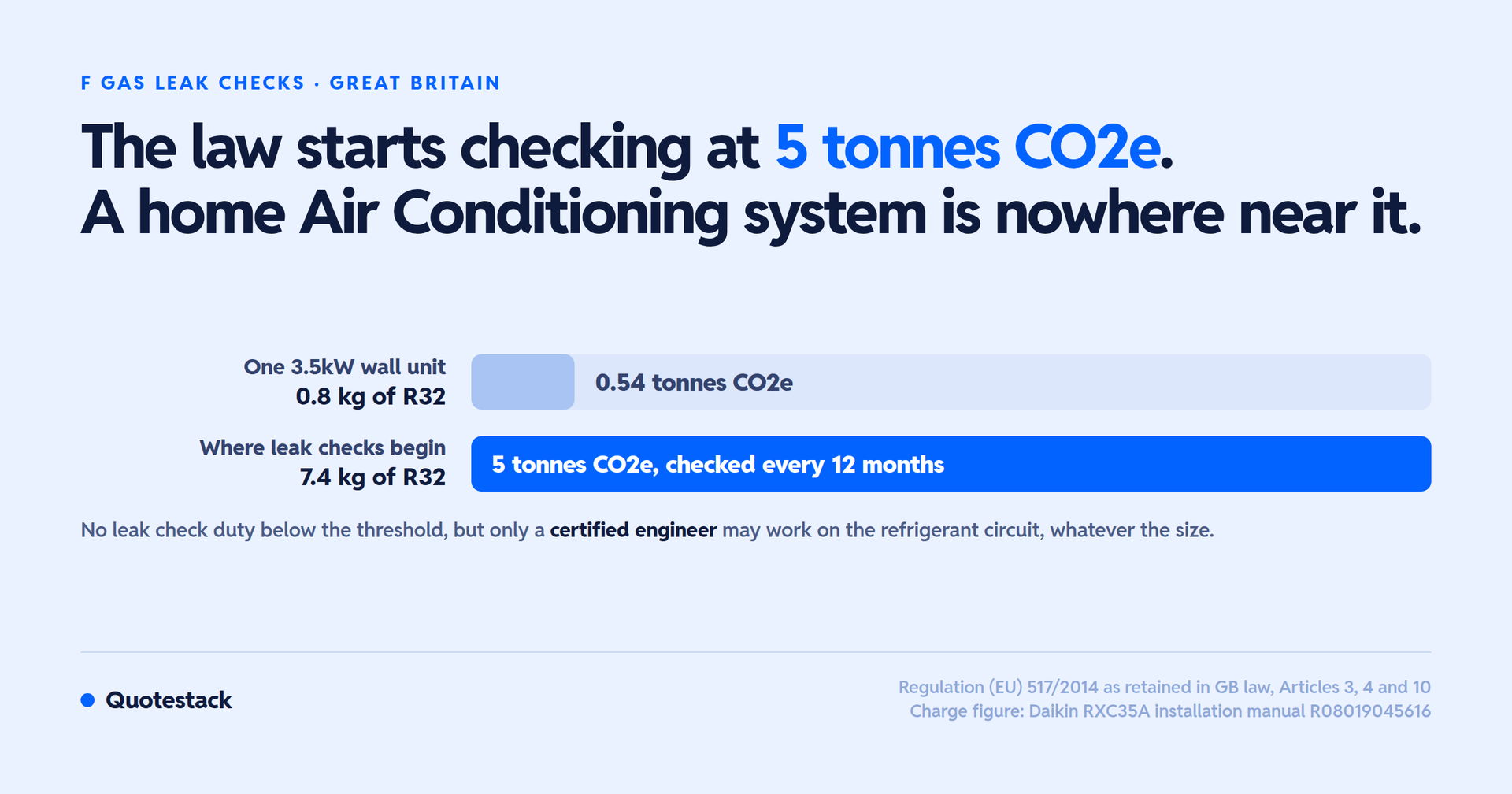
Article 4 of the same regulation sets the trigger at equipment containing fluorinated greenhouse gases in quantities of
5 tonnes of CO2 equivalent or more, with checks getting more frequent at 50 and 500 tonnes. Separately, hermetically sealed equipment holding less than 10 tonnes of CO2 equivalent is out of scope altogether, provided it is labelled as hermetically sealed.
Five tonnes of CO2 equivalent is a long way above what a typical single-room domestic split holds. Where a check is required, Article 4 says it has to be carried out by someone certified under Article 10, which loops back to step 2.
That does not make servicing pointless. A system that is low on refrigerant works harder and costs more to run, and filters and coils need attention. It just means that on most domestic installs, a service is maintenance rather than a statutory leak check, and it should be sold honestly as one.
If you run an Air Conditioning company, this is a selling point
Most of the above is invisible to the customer at the point they are choosing between three quotes. They cannot see a company certificate. They do not know Schedule 3 exists. So the installer who does all of it properly looks identical, on a quote, to the one who does not.
Which means it is worth saying out loud. Naming your certification scheme, saying which category your engineers hold, and telling a customer they will get a Building Regulations compliance certificate within 30 days is a genuine difference that costs you nothing to state, and it is the sort of detail that makes a homeowner trust the number on the page.
That is the same idea Quotestack is built on: putting the real information in front of a homeowner earlier, so an accurate pre-survey price and the reasons to trust it arrive together, on the installer's own website, before anyone picks up the phone.
Quick answers
Who can legally install Air Conditioning in the UK?
A business holding an F Gas company certificate, using engineers who hold a personal F Gas certificate in a category that covers the system. In England and Wales the work also has to be self-certified by a competent person scheme member or notified to building control.
Do I need to be F Gas certified to install Air Conditioning?
Yes, both personally and as a business. Sole traders need both.
Can I install Air Conditioning myself?
Not a fixed split system. Beyond the certification requirement, the equipment itself cannot legally be sold to you as an end user unless there is evidence a certified company is installing it. A plug-in portable is a different matter, because it is hermetically sealed.
Does Air Conditioning need Building Regulations approval?
In England and Wales, installing an air conditioning system in a dwelling is work a registered installer can self-certify under Schedule 3 of the Building Regulations 2010, which means it is otherwise notifiable to building control. Scotland and Northern Ireland have their own systems.
What paperwork should I get?
From a scheme-registered installer, a Building Regulations compliance certificate within 30 days of completion, under regulation 20 of the Building Regulations 2010.
How do I check an installer is certified?
REFCOM publishes a searchable register of the companies on its schemes, by name or postcode.
Does my new Air Conditioning need an annual leak check by law?
Only if it holds 5 tonnes of CO2 equivalent or more of F gas, which a typical domestic single room system does not.
Is any of this different in Northern Ireland?
Yes. Northern Ireland follows the EU's replacement F gas regulation rather than the version retained in Great Britain, and has its own building control rules.
Sources
All sources checked on 21 September 2026.