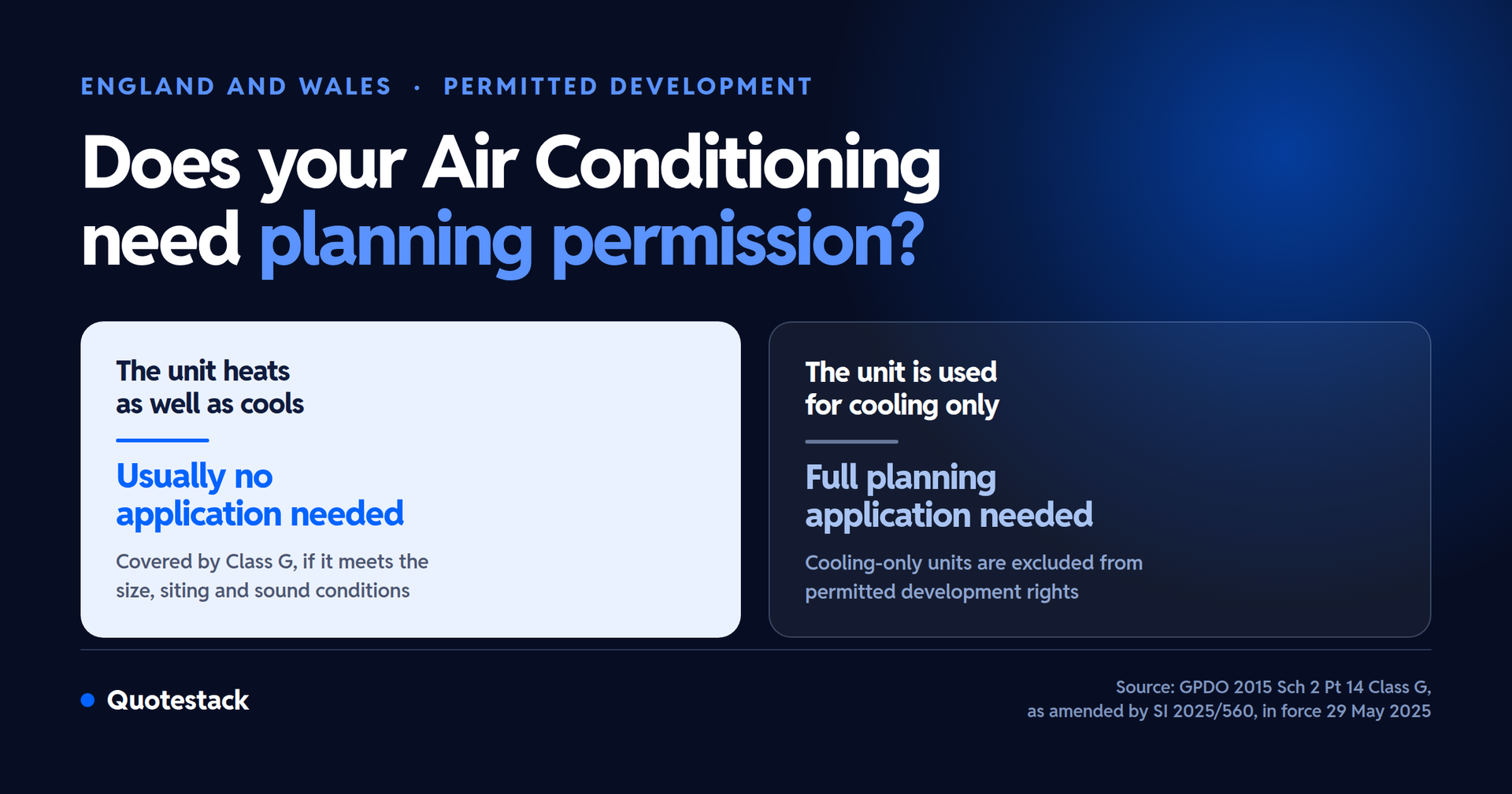
In most cases, no, as long as the unit heats as well as cools.
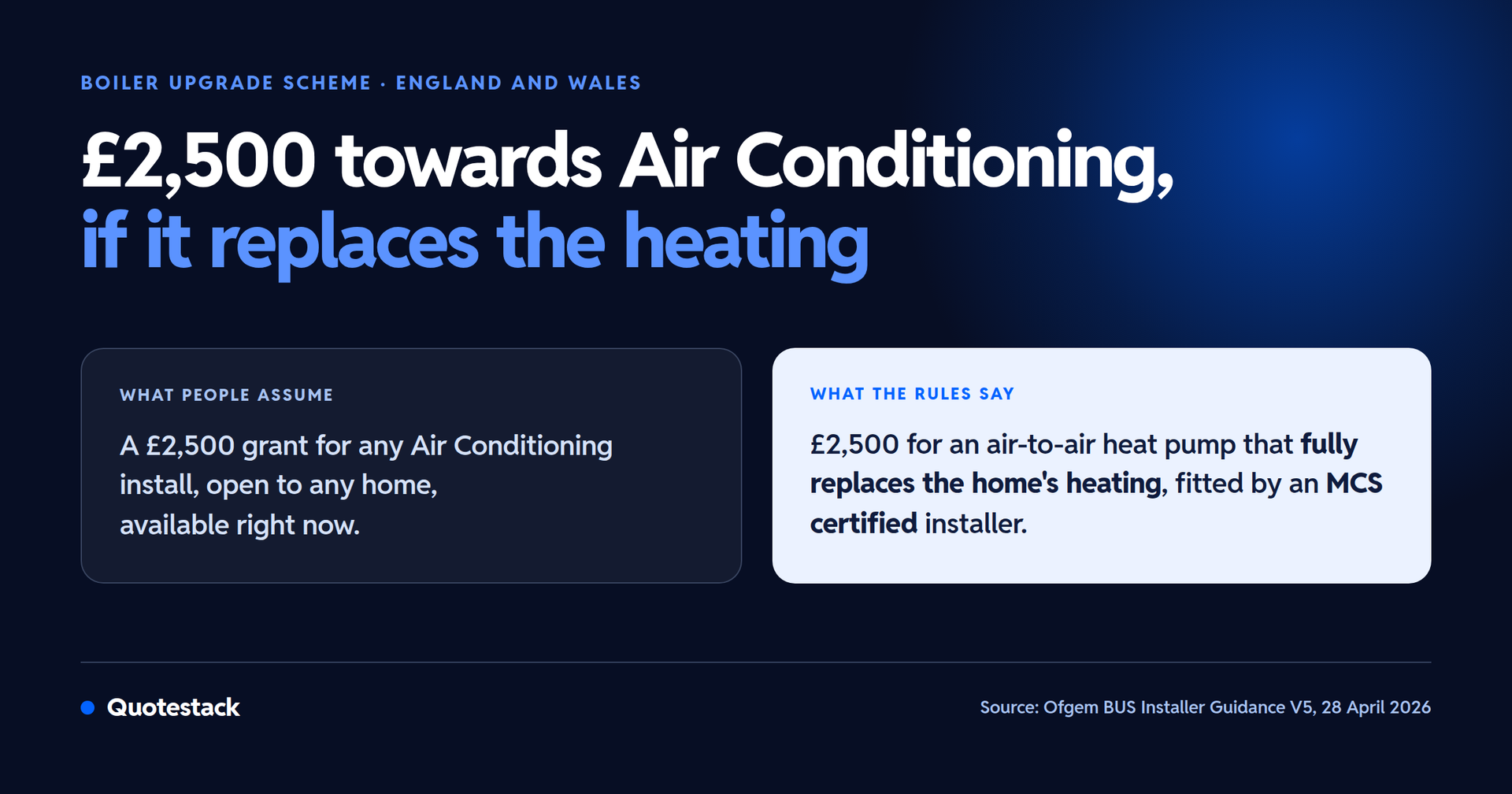
Since 29 May 2025 in England, and 1 June 2026 in Wales, a domestic Air Conditioning system that works as a reversible air-to-air heat pump can be installed under permitted development rights, which means no planning application. The catch is in the wording of the rules: a unit that is used
solely for cooling does not qualify, and needs a full planning application.
Almost every modern split system sold in the UK heats and cools. So for most homeowners, the honest answer is that planning permission is not needed, provided the installation also meets the size, siting and sound conditions set out below.
Here is what actually has to be true.
The rule that changed in May 2025
Domestic Air Conditioning has always sat awkwardly in UK planning law. The permitted development right that covers outdoor units is Class G of Part 14 of the General Permitted Development Order, and it is written around "air source heat pumps", not around Air Conditioning.
That changed with the Town and Country Planning (General Permitted Development) (England) (Amendment) Order 2025, which came into force on 29 May 2025. It did three things that matter to homeowners:
- It raised the maximum size of the outdoor unit on a house from 0.6 cubic metres to
1.5 cubic metres
- It
removed the old rule that the unit had to be at least one metre from the property boundary
- It added a new condition that the unit must not be used solely for the purpose of cooling
That last line is the one people miss. It is what separates a reversible heating and cooling system, which is covered, from a cooling-only system, which is not.
Wales made an equivalent change, with its own version of the rules taking effect on 1 June 2026. The Welsh guidance puts it plainly: the unit "must be for heating purposes or heating and cooling. It cannot be a unit designed for the purpose of cooling only."
The conditions a domestic install has to meet in England
Permitted development is not a free pass. All of the following have to be true, or the job needs a planning application.
Number of units
One outdoor unit on a terraced house, a semi-detached house or a block of flats. Two on a detached house. A third unit needs permission.
Size of the outdoor unit
The compressor unit, including its housing, must not exceed 1.5 cubic metres on a house, or 0.6 cubic metres on a block of flats.
Where it goes
Not on a pitched roof. On a flat roof, no part of it within one metre of the external edge. Outside a conservation area, it cannot go on a wall above ground floor level that fronts a highway. Inside a conservation area or World Heritage Site, it cannot go on any wall or roof fronting a highway, or nearer to a highway than the building itself.
No existing wind turbine
If there is already a standalone wind turbine in the garden, the heat pump does not get permitted development rights.
It has to heat
The system must not be used solely for cooling.
It has to be sited sensibly, and removed when finished with
The rules require the unit to be sited so as to minimise its effect on the external appearance of the building and on the amenity of the area, and to be removed as soon as reasonably practicable when it is no longer needed.
The sound rule, and the number a lot of people are quoting wrongly
This is where a lot of online advice is now out of date.
To use permitted development, the installation has to comply with the MCS Planning Standard, MCS 020. The 2025 amendment specifically pointed Class G at
MCS 020(a) - Air Source Heat Pump Sound Calculation (For Permitted Development Installations). There was a transition period, and from
28 May 2026 MCS 020(a) is the only version accepted in England.
The older MCS 020 worked to a limit of 42 dB(A). MCS 020(a) does not. In its published consultation response, MCS confirmed it would "change the overall limit to a corresponding limit of 37dB(A)".
So the current figure is
37 dB(A), not 42. If you are reading a guide that still says 42, it was written before the standard was updated.
In practice this means the installer runs a sound calculation before the unit is ordered, using the manufacturer's sound data and the position of the neighbouring habitable room windows. If the calculation comes in over the limit, the options are to move the unit, change the unit, add mitigation, or apply for planning permission. It is not something to discover on install day.
When you definitely do need planning permission
Straightforward list:
- Cooling-only systems. No heating function, no permitted development.
- Listed buildings. Class G does not apply. You will need listed building consent, and usually planning permission too.
- Scheduled monuments. Same position.
- A third unit on a detached house, or a second on a semi, terrace or flat.
- Units that break the siting rules, for example on a pitched roof, or on a street-facing wall in a conservation area.
- Anywhere an Article 4 Direction has removed permitted development rights. Some councils have these in place over specific areas. Worth a five minute check with the local planning authority before quoting.
Flats are also worth flagging separately. Permitted development rights are one thing, but a lease is another. Many leases require the freeholder's written consent before anything is fixed to an external wall, and that is a separate question from planning.
Scotland and Northern Ireland
The rules above are England and Wales. Scotland and Northern Ireland operate their own planning systems with their own permitted development rules, and the detail is different. If the property is in either, check with the local planning authority rather than assuming the English position carries over.
Why this matters more to installers than it looks
Planning is one of the questions that comes up early in a homeowner's head and almost never gets answered early in the sales process. They read three contradictory blog posts, half of them written before May 2025, and either talk themselves out of the job or arrive at the survey with a wrong assumption baked in.
The same thing happens with price. A homeowner wants a number before they commit to a survey, and the traditional process makes them wait for it. That gap is where enquiries go quiet. It is the reason Quotestack exists: it sits on an installer's own website and gives the homeowner an accurate pre-survey quote built from that installer's real pricing, before anybody drives anywhere.
Answering the planning question properly on your website does a similar job. It removes a reason to hesitate, and it does it for free.
Quick answers
Do I need planning permission for Air Conditioning in my house?
In England and Wales, usually not, if the unit heats as well as cools and meets the size, siting and sound conditions of Class G.
Does a cooling-only unit need planning permission?
Yes. The rules exclude units used solely for cooling.
How big can the outdoor unit be?
Up to 1.5 cubic metres on a house, or 0.6 cubic metres on a block of flats, including the housing.
Does it still need to be a metre from the boundary?
Not in England. That restriction was removed on 29 May 2025.
How loud can it be?
The MCS 020(a) sound calculation limit is 37 dB(A). The older 42 dB(A) figure no longer applies in England from 28 May 2026.
What about a listed building?
Permitted development does not apply. You will need consent, and specialist advice is worth getting early.
Sources