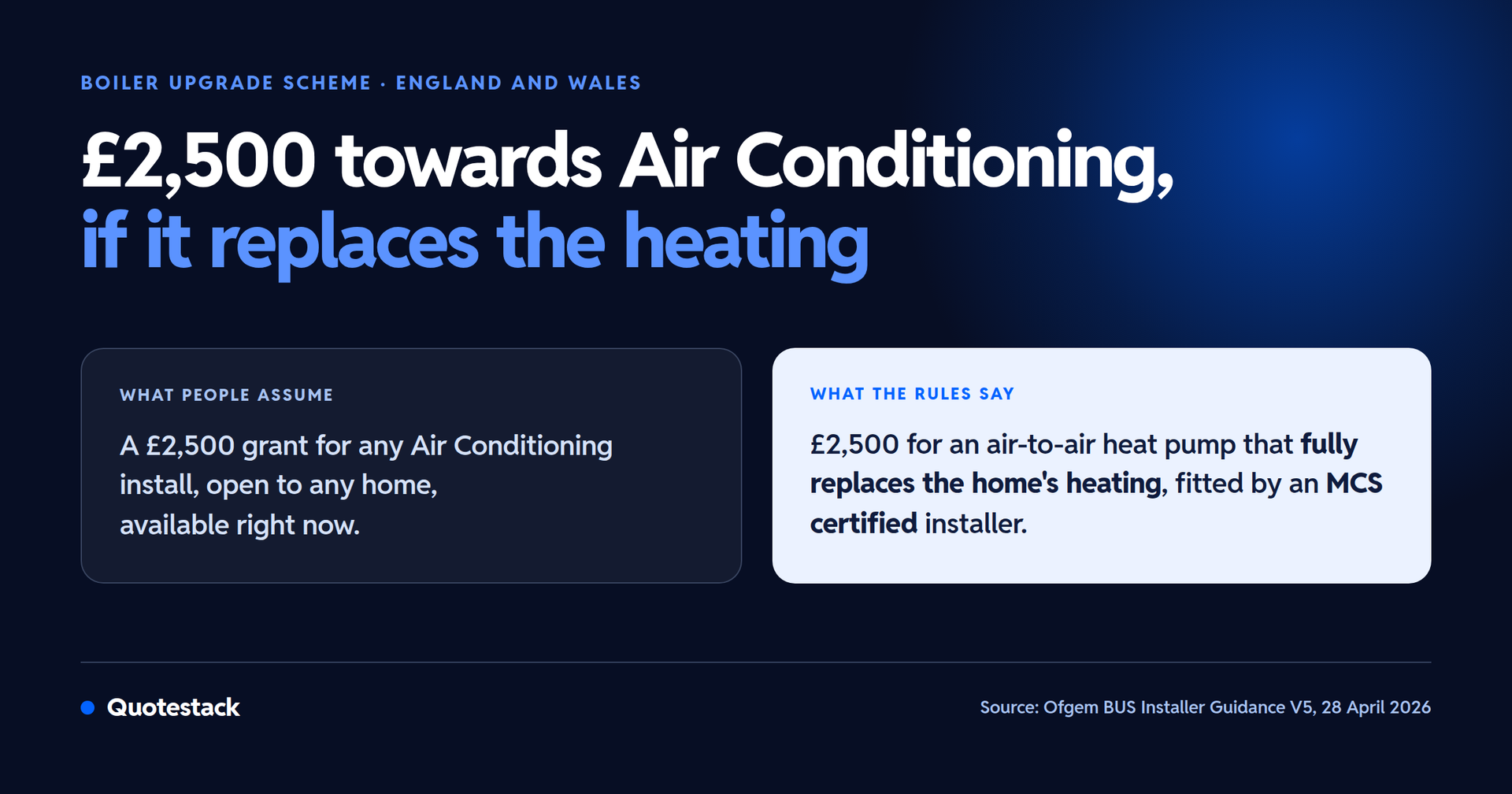
Yes, in England and Wales. A modern Air Conditioning system is an air-to-air heat pump, and the Boiler Upgrade Scheme now lists
£2,500 towards an air-to-air heat pump in a residential property.
Two conditions stop most Air Conditioning jobs from qualifying. The new system has to
fully replace the property's existing fossil fuel or electric heating, so adding cooling to a house that keeps its gas boiler does not count. And the installation has to be
MCS certified, which for air-to-air is only just becoming possible. Air-to-air was brought into the scope of the MCS Installer Scheme in September 2026, and certification bodies are still working through accreditation.
So the money is real and it is written into Ofgem's own rules. Getting your hands on it today is a different question. Here is exactly where it stands.
What the grant is
The Boiler Upgrade Scheme is the England and Wales grant for replacing fossil fuel heating with low carbon heating. On 18 November 2025 the government announced it was being extended to cover air-to-air heat pumps and heat batteries, as part of the Warm Homes Plan.
The grant levels now published on GOV.UK are:
- £7,500 towards an air source heat pump, which means air-to-water
- £7,500 towards a ground source heat pump
- £5,000 towards a biomass boiler
- £2,500 towards an air-to-air heat pump
Ofgem's Boiler Upgrade Scheme installer guidance, version 5, dated 28 April 2026, puts it as "£2,500 for air-to-air heat pumps (AAHP) (in residential properties only)". That residential-only restriction matters. Air-to-water and ground source can go into commercial buildings under the scheme. Air-to-air cannot.
Announcing it, Martin McCluskey, Minister for Energy Consumers, said air-to-air heat pumps "offer the best of both worlds, keeping you warm in winter while cooling you down when summer comes along". The government's own press release put a typical air-to-air installation in a flat or a small home at around £4,500, which is why £2,500 is a meaningful number rather than a token one.
The condition that rules most jobs out
This is the one to understand before anything else.
The system has to replace the home's heating. Ofgem's guidance says it "must fully replace the property's existing fossil fuel or electric heating system, except where supplementary heating appliances are permitted".
What counts as the thing being replaced:
- A fossil fuel system: gas, oil, LPG or coal
- An electric heating system that is not already a heat pump, which Ofgem lists as including storage heaters, electric panel radiators and electric boilers
That second bullet is the interesting one for Air Conditioning companies. A flat on electric storage heaters is a strong candidate. The homeowner gets heating and cooling from one system, the old heaters come out, and the job qualifies.
What does not count is the typical Air Conditioning enquiry: a house with a working gas boiler, and a customer who wants two rooms cooled in summer. The boiler stays, the heating is not replaced, and there is no grant. It is worth being straight with customers about that early, because a lot of the coverage online is not.
The MCS catch, and where it stands right now
Every Boiler Upgrade Scheme installation has to be MCS certified. Ofgem's installer guidance is blunt about it: "Installers must be MCS certified to install the heating system they are applying for under the Boiler Upgrade Scheme," and "All heating systems installed under the Boiler Upgrade Scheme must meet the relevant MCS standards approved and published by the Secretary of State." MCS describes itself as the sole certification scheme for clean heat measures under the scheme.
Air-to-air has been working its way into MCS since the announcement.
December 2025
MCS published updated standards covering air-to-air. MCS 007, the heat pump product standard, was revised. MCS 031 was split into 031a for hydronic heat pumps and 031b for air-to-air. MIS 3005-D, the design standard, gained a section on air-to-air system design.
April 2026
MCS confirmed it was working with certification bodies on UKAS accreditation, and set out the competence requirement for installers: the Technical Supervisor on an air-to-air installation has to hold competence in Refrigeration, Air Conditioning and Heat Pumps (RACHP) at Level 3 or above. That is a higher bar than air-to-water work, and it reflects the refrigerant handling involved.
September 2026
UKAS approved the updates to the MCS Installer Scheme, formally bringing air-to-air into scope for the first time. Certification bodies including NAPIT and Certsure then began their own route to accreditation. On the product side, Daikin has 65 residential multi-split and Multi+ combinations listed on the MCS Product Directory.
So the sequence is nearly complete but not finished. MCS's own consumer page still reads: "When air-to-air heat pumps are brought into the scope of MCS later this year, you may be able to access a grant of up to £2,500 for this technology." No date has been published for when the first air-to-air installers will hold certification.
The practical position for a homeowner today: you cannot yet pick an MCS certified air-to-air installer out of a list, because that list is still being built. For an installer, the practical position is that if you want this work, the RACHP Level 3 competence and a conversation with a certification body are the things to sort out now, not later.
The rest of the conditions
Assuming the heating replacement and the MCS certification are both satisfied, the remaining rules are straightforward.
You have to own the property. That includes a business premises, a second home, or a property let to tenants.
Residential only for air-to-air. Commercial buildings are out for this technology.
The installer applies, not you. GOV.UK is clear that the installer applies on the homeowner's behalf through Ofgem, and the grant comes off the quoted price.
120 days. The application has to be properly made within 120 days of the commissioning date. Miss the window and it cannot be re-applied for.
Capacity limits. 45 kWth for a single heat pump system, 70 kWth for a multi heat pump system.
No EPC needed. This one has changed and a lot of guides have not caught up. Ofgem's version 5 guidance states property owners are "no longer required to have a valid EPC to apply for BUS", though if the property has a valid EPC, the certificate number has to be given. Older advice saying you need an EPC with no outstanding loft or cavity wall insulation recommendations is describing a rule that no longer applies.
No double funding. A property already receiving government funding for a heat pump is not eligible.
Most new builds are out, as is social housing.
Scotland and Northern Ireland
The Boiler Upgrade Scheme is England and Wales only.
In Scotland, the Home Energy Scotland Grant and Loan offers up to £7,500 in grant funding for heat pumps, but the published terms state that only heat pumps providing 100% of a property's heating and hot water are eligible. An air-to-air system does not produce hot water, and air-to-air does not appear on the funded measures list. So on the published rules, an Air Conditioning system is not covered in Scotland.
Northern Ireland runs its own schemes and has no equivalent grant for air-to-air. Check locally rather than assuming the England and Wales position carries over.
What this means if you install Air Conditioning for a living
Two things are about to land at once.
The first is a wave of enquiries from homeowners who have read a headline about a £2,500 Air Conditioning grant and have not read the conditions. Most of them will not qualify, because their gas boiler is staying put. Being able to explain that clearly, early, and without sounding like you are talking them out of a job is going to separate the companies people trust from the ones people ring for a second opinion.
The second is a genuinely new market: homes on electric heating where a single air-to-air system replaces storage heaters, heats in winter, cools in summer, and comes with £2,500 off. That is a different conversation, a different customer, and worth being ready for.
Both conversations run into the same old bottleneck, which is that the homeowner wants a number and the traditional process makes them wait weeks for one. That gap is where enquiries go quiet. It is the reason Quotestack exists: it sits on an installer's own website and gives a homeowner an accurate pre-survey quote built from that installer's real pricing, before anyone drives anywhere.
Answering the grant question properly on your website does a similar job. It removes a reason to hesitate, and it costs you nothing.
Quick answers
Is there a government grant for Air Conditioning in the UK?
In England and Wales, yes. The Boiler Upgrade Scheme lists £2,500 towards an air-to-air heat pump in a residential property.
Can I claim it today?
Not yet in practice. The installation must be MCS certified, and air-to-air only entered the scope of the MCS Installer Scheme in September 2026. Certification bodies are still working through accreditation, and no date has been published for the first certified installers.
Can I get the grant if I am keeping my gas boiler?
No. The system has to fully replace the property's existing fossil fuel or electric heating.
Does replacing electric storage heaters count?
Yes. Ofgem lists storage heaters, electric panel radiators and electric boilers as electric heating systems that can be replaced under the scheme.
How much is the grant?
£2,500 for air-to-air. Air-to-water and ground source heat pumps get £7,500.
Do I need an EPC?
Not any more. Ofgem's version 5 guidance removed the requirement for a valid EPC, though the certificate number must be supplied if the property has one.
Is it available in Scotland?
Not on the published rules. The Scottish scheme funds heat pumps that provide 100% of heating and hot water, which an air-to-air system does not.
Who applies?
The installer, on your behalf, through Ofgem. The grant is deducted from the price you are quoted.
Sources
All sources checked on 14 September 2026.