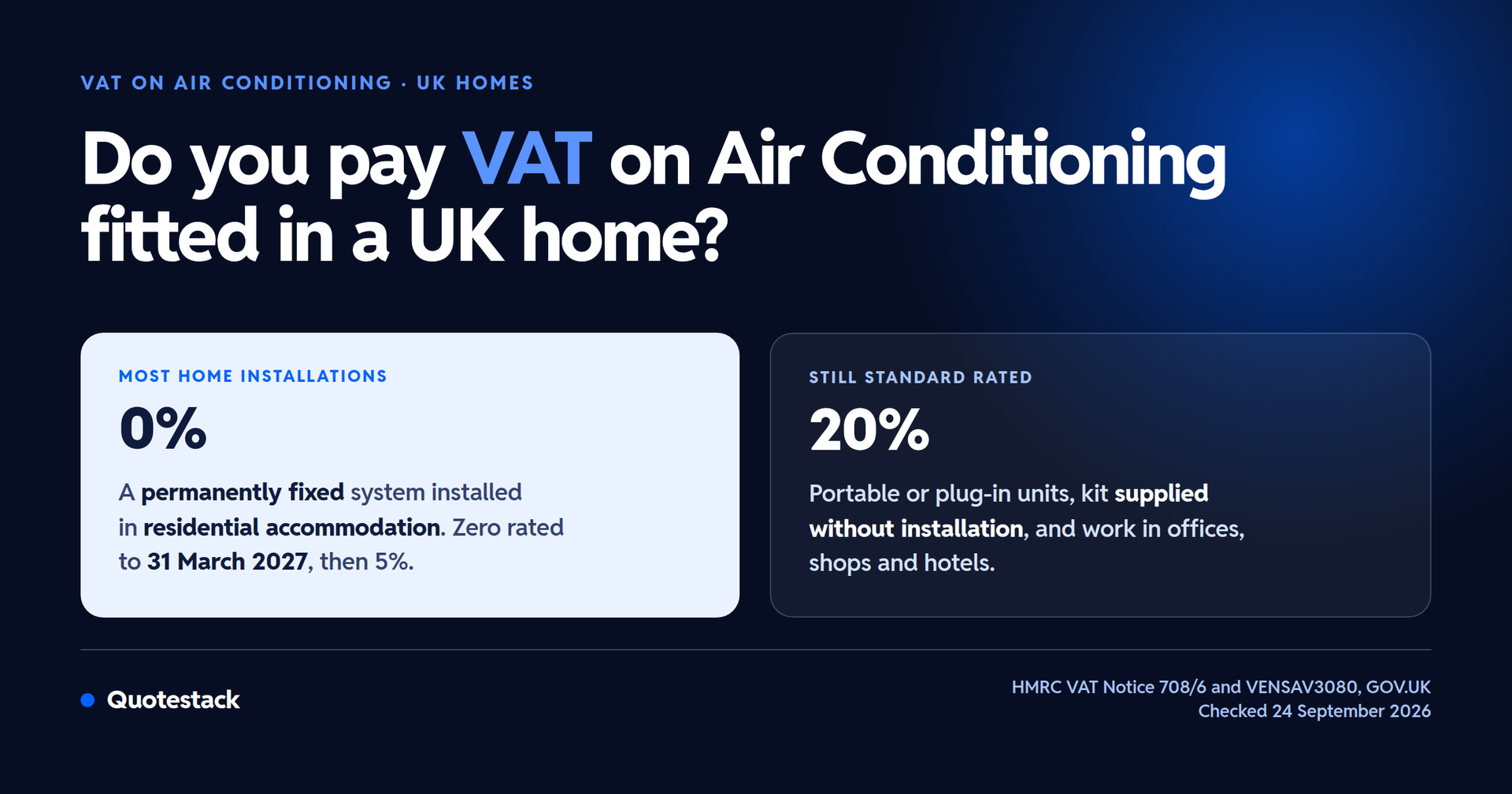
In most cases, no. Air Conditioning that is permanently fixed and installed in a home is treated by HMRC as an air source heat pump, which is on the list of energy-saving materials. That means the whole job, equipment and labour together, is zero rated for VAT until 31 March 2027. You still pay 20% VAT on portable units, on equipment bought without installation, and on work in offices, shops and hotels.
That is the short version. The detail is worth reading, because the relief has a fixed end date and three conditions that quietly rule jobs in or out.
Why Air Conditioning counts as an air source heat pump
This surprises people, homeowners and installers alike. The zero rate was sold publicly as a solar panels and heat pumps measure, so the assumption is that a split system for a bedroom has nothing to do with it.
HMRC’s own internal manual says otherwise. The guidance on air source heat pumps notes that fixed units “can be reversed so that they can draw heat from inside a building, thus providing cooling during the summer as well as indoor heating for colder periods of the year”, and then states plainly that “HMRC’s understanding is that most air conditioning units are air source heat pumps”.
So the mechanism your customer calls Air Conditioning is, for VAT purposes, the same mechanism HMRC calls an air source heat pump. Air source heat pumps are one of the qualifying energy-saving materials in VAT Notice 708/6, alongside insulation, solar panels, ground and water source heat pumps, wind turbines and a handful of others.
The three conditions that decide it
1. It has to be permanently fixed
The manual is specific: “only air source heat pumps that are permanently fixed and are not portable or moveable qualify as energy-saving materials”. A wall-mounted or ducted system wired and piped into the property is fixed. A plug-in portable unit on castors is not, and it carries standard rate VAT.
2. It has to be installed, not just supplied
The relief is for the installation of energy-saving materials, not the materials on their own. Notice 708/6 puts it bluntly: “If you supply energy-saving materials without installing them your supply will be standard-rated.”
That matters both ways round. A homeowner buying the kit online and finding a fitter later pays 20% on the equipment. A homeowner buying the system and the installation as one supply from one installer pays nothing on either part. There is no split between materials and labour to worry about any more, either. The old 60% threshold, where a job with a high materials cost had to be apportioned, applied from 1 October 2019 to 31 March 2022 and was removed when the zero rate came in.
Work that is genuinely part of the installation goes in at the same rate. The notice explains that an ancillary element “does not constitute, for the customer, an aim in itself, but is a better means of enjoying the principal supply”, and gives the example of cutting a new loft hatch to get at the loft for insulation. The equivalent on an Air Conditioning job is the bracketry, the pipe run, the condensate and the making good, rather than a separate bit of building work the customer wanted anyway.
3. It has to be residential accommodation
The relief covers houses, blocks of flats and other dwellings, plus places like care homes, children’s homes, hospices, student accommodation, caravans used as permanent homes and houseboats designed for permanent habitation.
It does not cover the commercial side of the trade. The notice says the standard rate applies to installations “in hospitals, prisons or similar institutions, hotels or inns or similar establishments”. A shop, an office or a restaurant is a 20% job. If you fit both, you are running two VAT treatments across the same week, which is exactly the situation where quotes go out with the wrong number on them.
One more case worth knowing: if the Air Conditioning goes in during the construction of a brand new dwelling, it is zero rated anyway, as part of the zero-rated construction of the building.
What happens on 1 April 2027
The zero rate is temporary. It ran in Great Britain from 1 April 2022 and was extended to Northern Ireland from 1 May 2023, and it is legislated to end on 31 March 2027. From 1 April 2027 the installation of energy-saving materials is due to move to the 5% reduced rate.
The House of Commons Library briefing on the subject, updated 24 September 2026, records no government announcement extending the relief beyond that date. So as things stand today, a home Air Conditioning installation completed on 31 March 2027 carries no VAT, and the same job completed a day later carries 5%.
The arithmetic is simple enough to say out loud to a customer: for every £4,000 of work, that is nothing today, £200 from April 2027, and £800 if the job had never qualified at all. Worth knowing if someone is sitting on a decision through the winter.
The grey area, honestly
HMRC does not say every Air Conditioning unit qualifies. It says most do, and then adds that “in cases of doubt, deciding whether any particular product is to be treated as an air source heat pump will depend on the facts of each case”.
The clearest case is a fixed, reversible system that heats as well as cools, because that is a heat pump doing the thing the guidance describes. A cooling-only fixed unit is the one where the facts start to matter, since the manual frames the technology around drawing heat into the building and treats cooling as the reverse of that. HMRC has not published a line either way on it, so anyone quoting a lot of cooling-only work is better off getting that confirmed with their accountant or in writing from HMRC than guessing. Mechanical ventilation with heat recovery, for what it is worth, is explicitly out: the manual says MVHR systems “do not qualify for the relief as they are not air source heat pumps”.
None of this is a reason to avoid the relief. It is a reason to know which of your jobs sit in the clear part of it.
What it means for the quote a customer sees
For a homeowner, the practical lesson is to check what the number in front of you includes. A price that says “plus VAT” on a fixed home installation is either a mistake or a sign that something about the job takes it outside the relief, and it is a fair question to ask.
For installers, VAT is one more rule that has to be right before a price reaches a customer, on top of product, margin, labour and the install rules for that particular property. Getting it wrong in either direction is expensive: quote 20% on a zero-rated job and you look dearer than the firm down the road for no reason, quote 0% on a commercial job and the VAT comes out of your margin.
That is the sort of thing worth building into the pricing rules once rather than remembering on every quote. It is the same logic behind Quotestack: the pre-survey price a homeowner sees on an installer’s website is built from that installer’s own pricing, margins and rules, so the number is right before anyone has driven anywhere.
The short answer, again
Fixed Air Conditioning installed in a UK home: 0% VAT until 31 March 2027, then 5%. Portable units, equipment without installation, and commercial premises: 20%. If the system is cooling-only, get it confirmed rather than assumed.
Sources
All checked 24 September 2026. HMRC,
VAT Notice 708/6. HMRC internal manual
VENSAV3080.
The Value Added Tax (Installation of Energy-Saving Materials) Order 2022. House of Commons Library briefing
CBP-8602.