For almost every home system, no. There is no law in Great Britain requiring an annual Air Conditioning service. The legal duty people are thinking of is the F Gas leak check, and it only applies to equipment holding 5 tonnes of CO2 equivalent of refrigerant or more. A typical wall-mounted home system holds roughly a ninth of that, so no leak check is legally required.
What does apply, to every system whatever its size, is that only a certified person may work on the refrigerant circuit, that refrigerant must not be knowingly released, and that a leak has to be repaired without undue delay. So the honest answer is not “you can ignore it”. It is “the yearly service is a manufacturer and reliability matter, not a legal one, and the law cares about who touches the system rather than how often”.
Where the legal duty actually starts
The rule sits in Regulation (EU) 517/2014, which was retained in Great Britain after Brexit and is still the regulation in force here. Article 4(1) says operators of equipment “that contains fluorinated greenhouse gases in quantities of 5 tonnes of CO2 equivalent or more and not contained in foams shall ensure that the equipment is checked for leaks”. Article 4(2) puts stationary Air Conditioning equipment and stationary heat pumps squarely on the list of what that covers.
Above that threshold the frequency scales with the charge:
- 5 to 50 tonnes CO2 equivalent: at least every 12 months
- 50 to 500 tonnes: at least every 6 months
- 500 tonnes and above: at least every 3 months
Fit a proper leakage detection system and each of those intervals doubles.
Note what the threshold is measured in. Not kilowatts, not the number of indoor units, not the age of the system. It is the climate impact of the refrigerant sitting in the pipes.
What 5 tonnes CO2 equivalent looks like in kilograms
This is where it stops being abstract. CO2 equivalent is the weight of refrigerant multiplied by its global warming potential, and Annex I of the regulation lists those values. R32, the refrigerant in most systems being fitted today, has a GWP of 675.
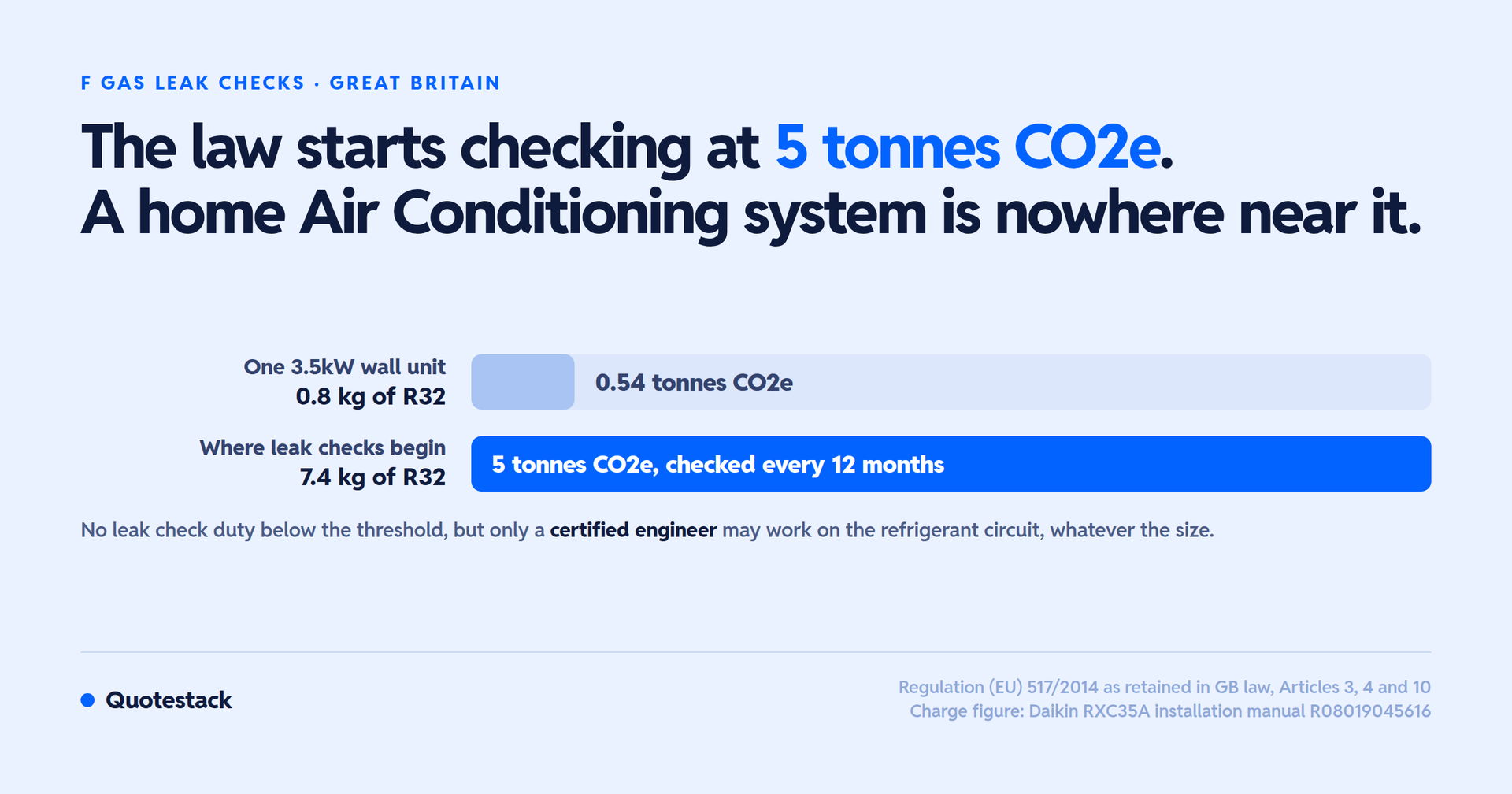
So the leak check threshold works out at 5,000 divided by 675, which is about
7.4 kg of R32.
Now the comparison. Daikin’s installation manual for its RXC series outdoor units gives a factory charge of 0.8 kg of R32 for the RXC35A, the 3.5kW unit that would typically serve one room, based on a 7.5m pipe run, plus 17 grams for every extra metre. At 0.8 kg, that system holds 0.54 tonnes CO2 equivalent. It would need to hold about nine times more refrigerant before a leak check became a legal duty.
Older systems sit closer to the line, because older refrigerant is worse. R410A is a half-and-half blend of R32 and R125, and Annex IV of the regulation says a blend’s GWP is the weighted average of its parts. R125 has a GWP of 3,500, so R410A comes out at about 2,088. That drops the threshold to roughly
2.4 kg of R410A. Still more than a single split holds, but a large older multi-split system in a big house is no longer a silly distance away from it.
One thing not to lean on: the separate exemption for hermetically sealed equipment below 10 tonnes CO2 equivalent. A normal split system is piped and charged on site, not sealed at the factory, so that exemption is not the one doing the work here. The 5 tonne threshold is.
The rules that apply to every system, whatever the size
This is the part that gets lost when people hear “no legal service requirement”.
Only certified people may work on it. Article 10 ties training and certification to the activities in Article 4(2): installation, servicing, maintenance, repair and decommissioning of stationary Air Conditioning equipment. There is no charge-size cut-off in that duty. The business needs a company certificate as well as the individual holding theirs. So a 0.8 kg system is outside the leak check rules and firmly inside the certification rules.
Refrigerant must not be released. Article 3(1) prohibits the intentional release of these gases where it is not technically necessary, and Article 3(2) requires operators to take precautions against leakage. Neither is limited by charge size.
A leak must be fixed promptly. Article 3(3): where a leak is detected, operators “shall ensure that the equipment is repaired without undue delay”. Again, no threshold.
Refrigerant must be recovered at the end. Article 8 requires that when equipment is serviced or decommissioned, recovery is carried out by certified people so the gas can be recycled, reclaimed or destroyed. Not vented. This one catches people who assume an old unit can simply be cut off the wall and skipped.
Records, though, follow the threshold. Article 6 ties the record-keeping duty to equipment “required to be checked for leaks pursuant to Article 4(1)”, and those records are kept for at least five years. Below the threshold, that particular paperwork duty does not bite.
So why does everyone still say service it every year?
Because the legal question and the sensible question are different questions.
A system losing refrigerant slowly does not usually announce itself. It gets less effective, works harder, costs more to run, and the first obvious symptom often arrives in the middle of a heatwave. Filters and coils foul up. And manufacturers set their own warranty conditions, which commonly involve documented maintenance, so anyone relying on a long warranty should read the terms for their specific system rather than assume either way.
None of that is the law telling you to book a service. It is the system and the warranty telling you to. Worth being straight about which is which, because “it’s a legal requirement” is the kind of line that quietly costs a company trust when a customer looks it up.
Is any of this about to change?
The GB regulation is under review, but it has not changed. Defra announced in May 2026 that it was delaying its proposed changes to the phase down and needed further work before deciding, and the existing GB F Gas regulation remains fully in force. The separate HFC quota reduction still steps down from 31% of baseline to 24% from 1 January 2027, which affects refrigerant supply and price rather than the leak check thresholds discussed here.
One scope note: this is the Great Britain position. Northern Ireland remains subject to EU F-gas legislation rather than the GB retained regulation, so anyone working there should check the EU rules separately.
What this means if you quote maintenance
If you sell maintenance plans, the strongest version of that pitch is the true one. Most domestic customers are not buying legal compliance, they are buying reliability, efficiency and a warranty that stays intact. On commercial work the picture flips, because larger systems genuinely do cross 5 tonnes CO2 equivalent, and then the leak checks, the records and the intervals are real obligations with a real cost attached.
That difference belongs in the price rather than in a conversation on the doorstep. Which is the general problem with pricing this trade: the rules that change the number, whether that is the refrigerant, the property, the system size or the compliance work attached, are all known before anyone drives anywhere. It is the thinking behind Quotestack, where the pre-survey price a homeowner sees is built from that installer’s own pricing and install rules rather than a guess.
The short answer, again
No law requires an annual Air Conditioning service on a normal home system in Great Britain. Leak checks are legally required only from 5 tonnes CO2 equivalent, which is about 7.4 kg of R32 or 2.4 kg of R410A, and a single wall unit holds well under a kilogram. What is legally required at any size: a certified engineer, no deliberate release, prompt repair of leaks, and proper recovery at the end of the system’s life.
Sources
All checked 28 September 2026.
Regulation (EU) 517/2014 Article 4 as retained in GB law, plus
Article 3,
Article 6,
Article 8,
Article 10,
Annex I and
Annex IV. Refrigerant charge figure from the Daikin R32 Split Series installation manual R08019045616. Certification and record-keeping summary from
NetRegs.